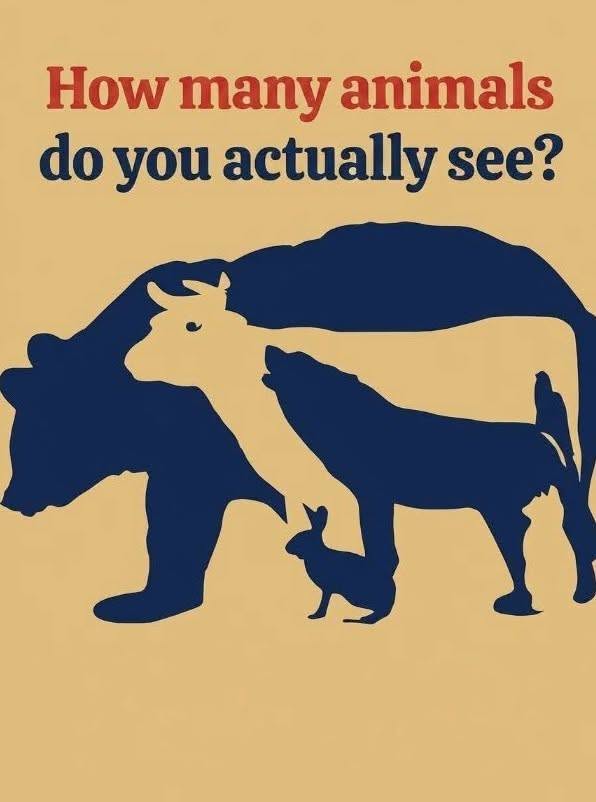
When we look at a complex optical illusion, our brains act as highly efficient pattern-matching machines. Once we confidently identify the largest, most prominent shapes, such as a bear or a cow, our minds often stop actively searching.
ADVERTISEMENT
This phenomenon, known as inattentional blindness, causes us to look directly at smaller details, like a mouse or a cat, while our brain filters them out as mere background noise.
We see what we expect to see, not necessarily what is actually there. Our brains are designed for efficiency, meaning that once a pattern is recognized, we stop processing the finer details and simply fill in the gaps based on our expectations.
To overcome this mental shortcut, the puzzle forces us to engage with negative space, which refers to the empty areas between drawn objects. By doing so, it hacks our natural pattern-recognition software, leveraging pareidolia.
This is our innate tendency to find familiar shapes, like faces or animals, in ambiguous stimuli. Combined with Gestalt principles, which drive us to organize visual elements into meaningful wholes, this technique completely shifts how we perceive the image.
ADVERTISEMENT
Keep reading on the next page 
Decoding the Canvas: What to Look For
In these intricate puzzles, the creatures you might discover range from the obvious to the deeply concealed. The most prominent figures typically include a large, dark bear shape on the left and a central cow.
Both are easy to spot and help establish the primary structure of the image. A cat with pointed ears toward the right is moderately difficult but recognizable once you know where to look, while a smaller mouse near the lower center is easily overlooked at first glance.
There’s more just ahead — continue on the next page 
Beyond these, the true challenge lies in the hidden animals formed by overlapping outlines and negative space. You might find a bird in the gap between the bear’s legs or above the cow, a rabbit tucked into the cow’s underbelly, or a fish hidden within curved empty spaces.
Other cleverly disguised figures can include a dog formed by intersecting shapes, an elephant occupying larger negative areas, or a butterfly created by symmetrical gaps.
Strategies for Discovery
Finding every hidden animal requires a deliberate shift in how you process visual information. Instead of focusing on the dark, drawn objects, direct your attention to the white spaces between them.
You can also defocus your eyes slightly to blur your vision, which helps you perceive overarching patterns rather than individual details. Turning the image upside down or viewing it from different angles disrupts your brain’s automatic pattern recognition, making hidden shapes suddenly apparent.
Tap to the next page to keep reading 
A systematic scanning approach is also highly effective. Start by identifying the obvious animals, then carefully check the borders, corners, and areas where shapes overlap.
Pay special attention to symmetrical spaces, as these often form the trickiest hidden figures. If you find yourself stuck, take a mental reset. Step away for a few minutes, ask someone else to look with fresh eyes, or try verbalizing what you see, as describing the image forces your brain to process the information through a different cognitive pathway.
The Psychology and Cognitive Rewards
The addictive nature of these puzzles is deeply rooted in human psychology. Discovering each hidden animal delivers a small dopamine hit, while the curiosity gap of wondering how many more are left keeps you engaged.
Our brains naturally crave pattern completion, making the sudden recognition of a hidden shape, often called an Aha moment, deeply satisfying and highly shareable.
Beyond entertainment, these exercises offer genuine cognitive benefits. They improve visual processing, enhance attention to detail, strengthen pattern recognition, develop flexible thinking, and train selective attention.
Read more on next page
ADVERTISEMENT
We’re not done yet — the next page continues
The Artistry of the Illusion
Crafting these visual puzzles is a delicate art form. It requires a deep understanding of Gestalt psychology, mastery of negative space, and knowledge of how the human brain processes visual information.
ADVERTISEMENT
The artist must possess the skill to create ambiguous shapes and the patience to test and refine the design. The most successful puzzles strike a perfect balance between difficulty and clarity, ensuring the animals are challenging to find but undeniably there upon careful inspection, while delivering unexpected placements that make the final discovery deeply rewarding.
ADVERTISEMENT
Frequently Asked Questions
Many people wonder why they cannot see all the animals even after being told they exist. This happens because the brain has already established a visual map of the scene, making it difficult to override that initial perception.
Resetting your view by looking at the image from a distance or turning it upside down can help break this mental block.
Turn to the next page for the rest of it…
