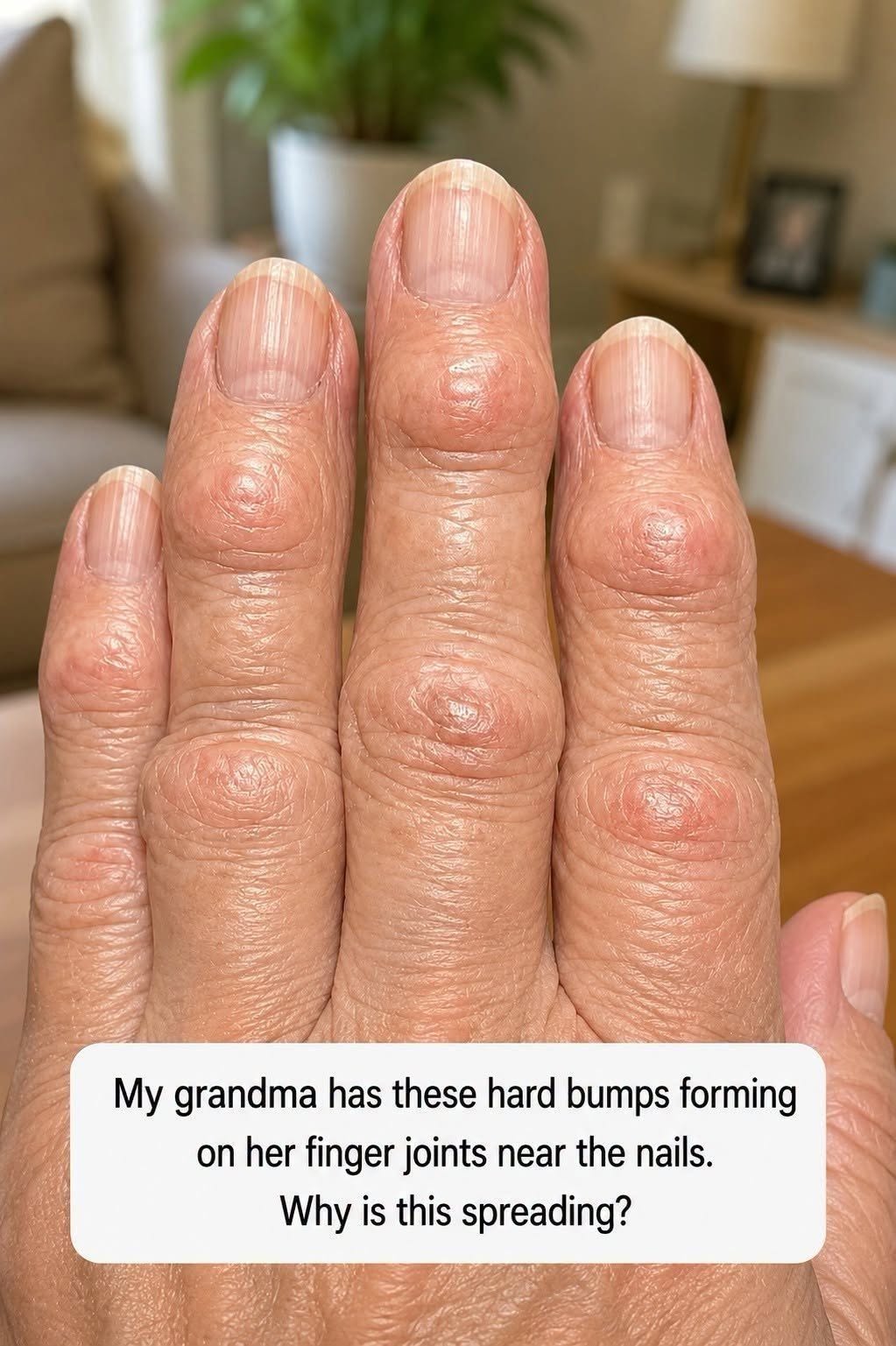
As we get older, our bodies naturally change—and our hands are no exception. One common change many people notice is the development of hard, bony bumps on the joints closest to the fingertips. These bumps may start on one finger and gradually appear on others, making everyday tasks like buttoning clothes or opening jars more difficult.
Although they can look concerning, these growths are often a common sign of osteoarthritis, the most prevalent form of arthritis.
What Are Heberden’s Nodes?
The hard bumps that develop on the joints nearest the fingernails are called Heberden’s nodes.
They form when the cartilage that cushions the finger joints gradually wears away. As the protective cartilage breaks down, the bones begin rubbing against each other. In response, the body produces extra bone around the joint, creating the firm enlargements that become visible beneath the skin.
Unlike soft swelling caused by inflammation, Heberden’s nodes are bony growths and usually feel hard to the touch.
Why Do They Appear on More Fingers Over Time?
Osteoarthritis is a progressive condition, meaning it can worsen gradually over the years.
As joint wear continues, additional finger joints may become affected, causing more nodes to develop.
Several factors can increase the likelihood of developing Heberden’s nodes, including:
Aging
A family history of osteoarthritis
Years of repetitive hand movements
Previous finger injuries
Women—particularly after the age of 45 and around menopause—are more likely than men to develop these bony enlargements.
Common Symptoms
In addition to the visible bumps, people with Heberden’s nodes may experience:
Pain or tenderness in the finger joints
Stiffness, especially in the morning
Swelling around the affected joints
Reduced flexibility
Difficulty gripping or holding small objects
Over time, the affected fingers may gradually change shape as the joints become enlarged.
Could It Be Something Else?
While Heberden’s nodes are most commonly associated with osteoarthritis, other medical conditions can also affect the finger joints.
For example, rheumatoid arthritis, an autoimmune disease, may cause pain, swelling, stiffness, and joint deformities. However, it typically affects different joints and often involves both hands symmetrically.
If your symptoms appear suddenly, become extremely painful, or are accompanied by significant swelling, redness, fever, or unusual fatigue, it’s important to seek medical evaluation to determine the underlying cause.
How Are Heberden’s Nodes Diagnosed?
Doctors can often identify Heberden’s nodes through a physical examination.
