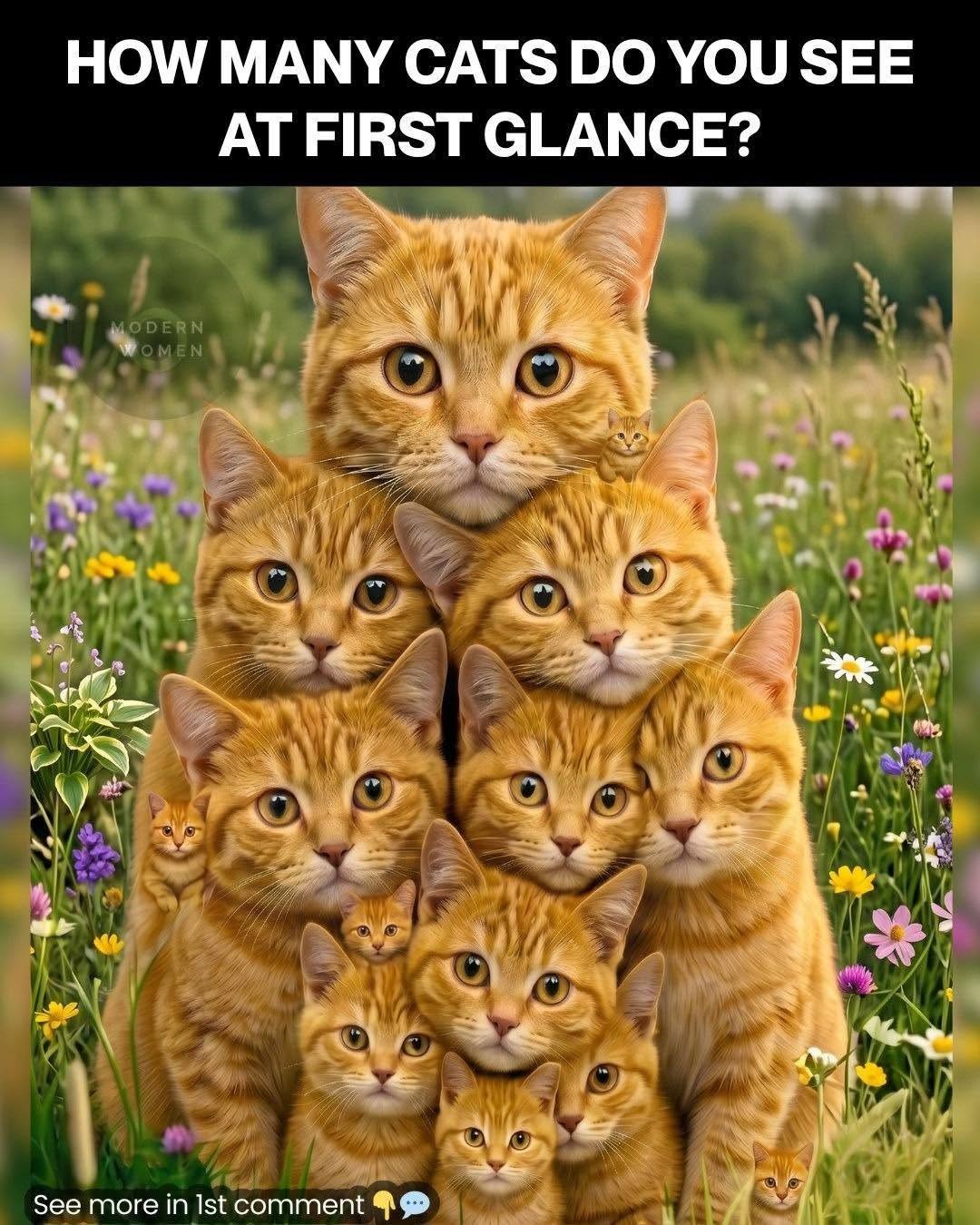
At first glance, this image seems simple enough: a sweet illustration of a fluffy ginger cat family gathered together in a colorful spring meadow.
Cute, cozy, harmless.
But don’t let those oversized eyes and soft orange fur fool you—this picture is actually a cleverly designed visual puzzle that has left thousands of people completely stumped.
I first saw this image on social media. A friend posted it with the caption: “I found 6. My husband says 9. My daughter says 12. How many do YOU see?”
The comments were a war zone. People were confidently declaring answers ranging from 5 to 15. Some claimed to see cats hiding in the flowers, the clouds, even the patterns on the cats themselves.
I zoomed in. I squinted. I turned my phone upside down. I counted. Then I counted again. Each time, I found a new cat I’d missed before.
This puzzle isn’t just about counting what’s obvious. It’s about training your brain to see what’s hidden in plain sight.
Let me walk you through what makes this optical illusion so tricky—and how to find every single cat.
The artist has used several clever techniques to hide cats in plain sight.
1. Pattern integration. Cats are hidden within the fur patterns of the larger cats. A swirl of orange fur might actually be a tiny cat face.
2. Negative space. The spaces between objects (leaves, flowers, clouds) are shaped like cats.
3. Background blending. Cats are camouflaged into the meadow, the sky, and the foliage.
4. Perspective tricks. Some cats are drawn at odd angles, making them easy to miss on first glance.
5. Size variation. Tiny cats hide inside larger cats. Medium cats hide behind flowers. Large cats blend into the landscape.
The result? Your brain sees the obvious cats first and stops looking. The hidden cats require deliberate, focused searching.
Don’t just stare and guess. Use a system.
Step 1: Count the obvious cats. These are the cats you see immediately. Usually 3-5.
Step 2: Scan the background. Look at the clouds. Look at the flowers. Look at the trees. Are any shapes cat-like?
Step 3: Check the fur patterns. Look closely at the orange stripes on the large cats. Some stripes form tiny cat faces or silhouettes.
Step 4: Examine the negative space. The gaps between leaves, petals, and blades of grass—some are shaped like cats.
Step 5: Turn the image upside down. A fresh perspective reveals hidden shapes you missed right-side up.
Step 6: Squint or blur your eyes. Sometimes the overall pattern reveals cats that individual details obscure.
Step 7: Count methodically, then count again. Use a finger to point to each cat as you find it. Mark them on a piece of paper.
