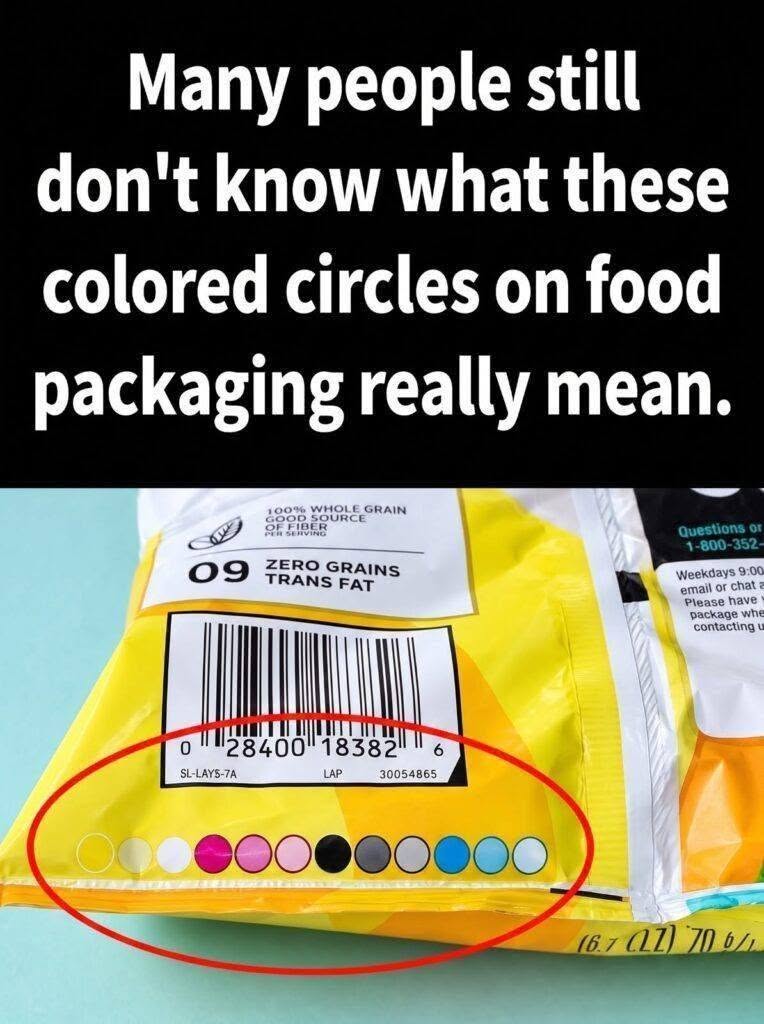
Have you ever picked up a package of food and noticed a row of tiny colored circles, squares, or blocks near the bottom?
Maybe they’re red, yellow, blue, black, or a combination of several colors.
If you’ve noticed them before, you may have wondered whether they have something to do with the ingredients, food quality, expiration dates, or even the safety of what’s inside.
I know I did!
It’s one of those little packaging details that’s easy to overlook because we’re usually much more interested in what’s printed on the front of the package.
But those colorful marks actually do have a purpose—and surprisingly, that purpose has very little to do with the food inside.
What Are the Colored Circles on Food Packages?
Those small colored circles or squares are generally known as printer’s color blocks, color control patches, or printer’s marks.
They’re used during the commercial printing process and are primarily intended for the people who manufacture and print the packaging, rather than for shoppers.
These marks help printing technicians monitor ink colors and assess whether the printed packaging is meeting the intended color standards.
So, if you’ve ever wondered why a bag of chips, cereal box, cracker package, or other food package has mysterious little colored blocks near an edge, you may simply be looking at a quality-control tool used during printing.
Why Do Printers Need Those Colored Blocks?
Think about how important color is to a food brand.
A company’s logo, package design, and signature colors are often instantly recognizable. Imagine if the red on a familiar package suddenly appeared dark burgundy in one production run and bright orange-red in another.
It might seem like a small difference, but consistent branding matters.
That’s where color control marks can help.
During printing, technicians can examine color patches to assess whether the inks are producing the expected results. They may compare the printed colors against established standards and adjust the printing process when necessary.
The goal is simple: make sure the packaging looks the way it’s supposed to look.
Why Are There Sometimes Several Different Colors?
You might see several colored circles or squares grouped together, and there’s a practical explanation for this.
Many commercial printing processes use a combination of ink colors to reproduce a wide range of colors on packaging.
One familiar example is the CMYK color system:
- C — Cyan: A blue-green color.
- M — Magenta: A reddish-purple color.
- Y — Yellow: Yellow ink.
- K — Black: Black ink, used for details, contrast, and darker areas.
These four colors can be combined in different proportions to reproduce a wide range of colors.
Depending on the printing method and package design, additional colors or specialty inks may also be used.
The exact arrangement of the marks isn’t the same on every package. Some have only a few color patches, while others may feature a larger selection.
Why Are the Marks Usually Near the Bottom or Edge?
What Those Colored Circles on Food Packaging Really Mean
Why Are the Marks Usually Near the Bottom or Edge?
There’s a practical reason you often find these marks in an out-of-the-way location.
They’re primarily intended for printing and manufacturing professionals, so they generally don’t need to be prominent parts of the package design.
Depending on the packaging and printing process, they may appear along an edge, near the bottom, or in another area that doesn’t interfere with the main artwork, branding, or consumer information.
That also explains why you may have looked at hundreds of packages without ever really noticing them.
They’re there. They’re just not meant to grab your attention.
What Do Printing Technicians Look For?
Color control patches and related printing marks can help technicians evaluate the consistency and quality of the printing process.
Here are some of the things they may check:
1. Color consistency
Does the printed ink match the expected color?
2. Ink density
Is the amount of ink being applied producing the intended appearance?
3. Registration
Are the different layers of ink lining up correctly?
4. Print quality
Are there problems with ink application, the printing press, or other parts of the production process?
These checks help maintain consistent results throughout a print run.
And when a company is producing thousands or even millions of packages, consistency becomes extremely important.
What Happens If the Colors Aren’t Right?
If a technician notices that a color isn’t matching the expected standard, adjustments can be made during production.
Depending on the printing process, this might involve adjusting ink levels, correcting registration, fine-tuning the press, or addressing another printing issue.
The goal is to catch problems before large quantities of packaging are produced with noticeable color differences.
So, those tiny circles can be part of a surprisingly useful quality-control process.
Do All Food Packages Have These Marks?
No. You won’t necessarily find printer’s color blocks on every food package.
Their appearance depends on several factors, including the printing method, packaging material, artwork, printer, and production process.
Some packages may use different types of registration or quality-control marks, while others may have marks that are less obvious or difficult to spot.
So, don’t be surprised if you inspect your pantry and find colorful blocks on some packages but not others.
What About the Little Numbers and Lines You Sometimes See?
You may also notice tiny numbers, bars, symbols, lines, or patterns on food packaging.
These can serve different purposes.
Some may relate to printing registration or color control. Others may be production marks, cutting guides, codes, or information used during manufacturing.
Not every small mark serves the same function, so it’s best not to assume that all packaging symbols have a single meaning.
Packaging is a surprisingly technical process!
Are the Colors Related to the Food Inside?
No—not in the way many people assume.
Those little color blocks generally aren’t a secret code telling you what’s inside the package.
They don’t normally indicate:
- Whether the food is healthy.
- How fresh the food is.
- How processed it is.
- Whether it contains artificial ingredients.
- How much sugar or salt it contains.
- Whether the food is organic.
- Whether the package has been recalled.
- The expiration or best-by date.
For this information, you’ll need to check the appropriate parts of the packaging, such as the ingredient list, nutrition label, date marking, storage instructions, or applicable product notices.
The colored marks are primarily associated with printing and production quality control, not a standardized food-rating system.
