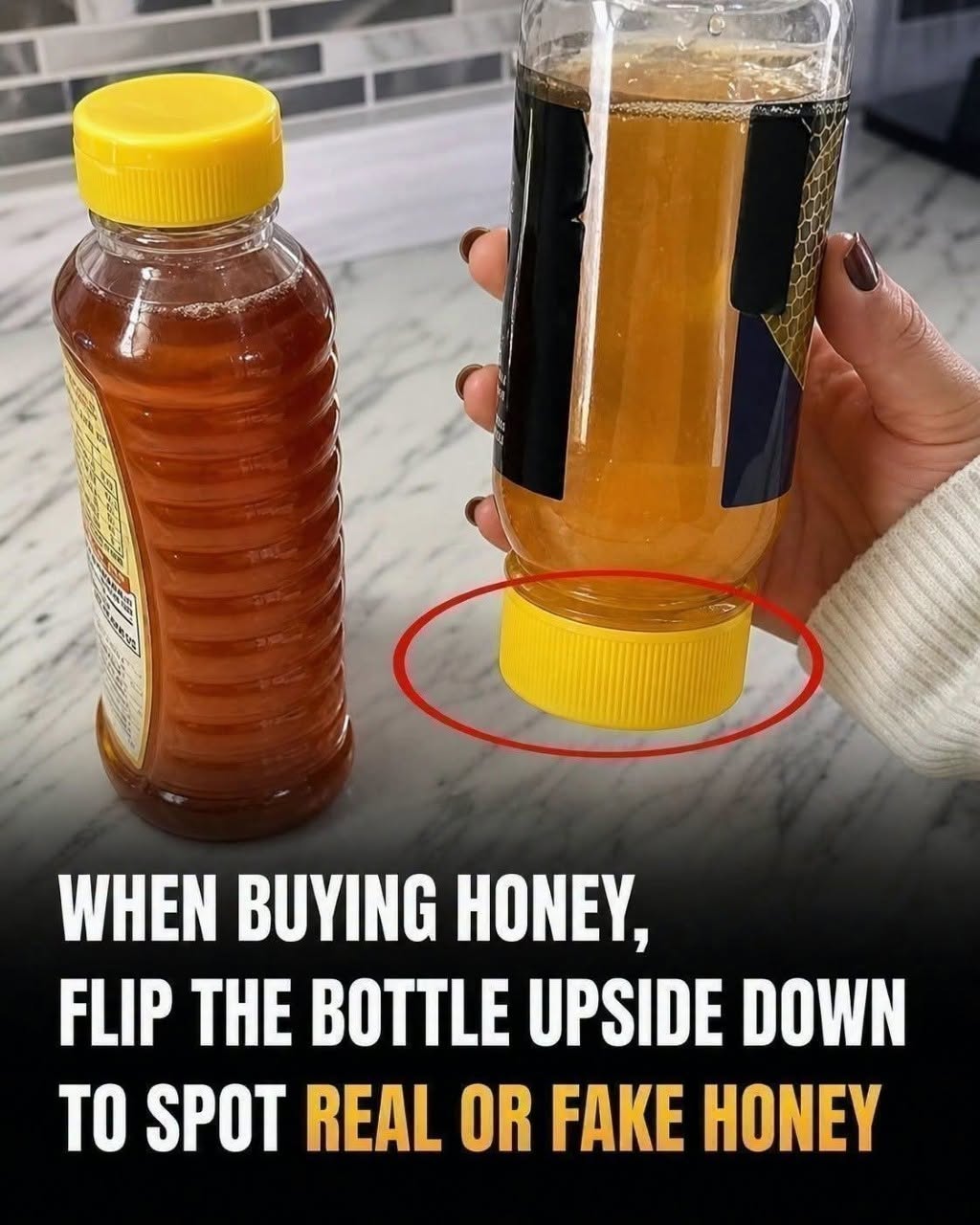
Flip the Honey Bottle and Watch What Happens – Can This Test Really Tell If Honey Is Pure?
Honey has been valued for thousands of years for its distinctive flavor, long shelf life, and versatility. It can sweeten tea, complement breakfast foods, become part of a marinade, or simply be enjoyed by the spoonful.
But whenever people buy honey, one question often comes to mind:
Is this really pure honey?
That question has become even more common as social media has popularized simple “honey tests” that claim to reveal whether a jar contains authentic honey. One of the most popular involves something that requires almost no equipment at all: turning the honey bottle upside down and watching what happens.
According to the viral claim, real honey supposedly forms a particular bubble, moves slowly, or behaves differently from diluted or fake honey.
It is an appealing idea because it seems so simple.
There’s more to discover. Continue to the next page for the rest of this article.
No laboratory.
No special equipment.
No complicated chemistry.
Just flip the bottle and look.
But can this really tell you whether honey is authentic?
The short answer is: not reliably.
The way honey moves inside a bottle can provide clues about its physical properties, but it cannot by itself prove that honey is pure, authentic, or free from added sweeteners.
To understand why, it helps to look at what honey actually contains, why it behaves the way it does, and what home tests can and cannot tell you.
Why Does Honey Move So Slowly?
The first thing you notice when flipping a bottle of honey is usually its thickness.
Unlike water, honey does not rush toward the other end of the container.
It moves slowly, sometimes leaving a thick trail behind. A bubble may travel through it gradually, while the liquid can appear almost motionless for several seconds.
This happens
There’s more to discover. Continue to the next page for the rest of this article.
because honey has a relatively high viscosity.
Viscosity describes a fluid’s resistance to flowing.
Water has low viscosity, which is why it flows rapidly.
Honey has much higher viscosity, so it moves much more slowly.
But viscosity isn’t determined by authenticity alone.
Temperature, moisture content, sugar composition, crystallization, and even the type of honey can influence how thick it appears.
That is why two completely genuine honeys can behave differently when you turn their containers upside down.
What Happens When You Flip a Honey Bottle?
Imagine a bottle that is nearly full of honey.
You turn it upside down.
The honey begins to move toward the cap while an air bubble travels in the opposite direction.
Some viral tests suggest that if the air bubble rises slowly or forms a certain shape, the honey must be pure.
But this conclusion is too simplistic.
The speed of the bubble depends on
There’s more to discover. Continue to the next page for the rest of this article.
several physical factors.
Temperature is particularly important.
Cold honey becomes thicker and flows more slowly.
Warm honey becomes less viscous and flows more easily.
That means the exact same honey can behave differently depending on whether the bottle has been sitting in a cool kitchen, a warm cupboard, or direct sunlight.
The bottle itself also matters.
A narrow container can produce different visual effects from a wide jar.
The amount of honey, the size of the air bubble, and the angle of the bottle can all influence what you observe.
So while flipping the bottle can be an interesting demonstration of honey’s viscosity, it is not a reliable authenticity test.
Why the “Bubble Test” Became Popular
The attraction of the bottle test is easy to understand.
People want a quick way to protect themselves from poor-quality products.
Honey can be relatively expensive compared with ordinary sugar, and consumers naturally want.
